
Federalism is the division of power between a central authority and various constituent units such as states

Table of Contents
- What is Federalism?
- What are the General
- Characteristics of Federalism?
- How did federalism evolve in India over time?
- Federalism in post-independent India
- What is the significance of Indian federalism?
- What are the federal provisions under the Indian Constitution?
- What are the unitary features of the Indian constitution?
- Why is Indian federalism considered Quasi-federal?
What is Federalism
Federalism refers to a system of government in which power is divided between a central authority and various constituent units, such as states or provinces.
- In India, the constitution divides powers and responsibilities between the central government and the state governments. The division of powers is further enhanced by a third tier of government, the local self-government.
- Federalism in India allows for both national unity and regional diversity, as it allows the central government to implement policies that apply uniformly throughout the country while also allowing the states to tailor policies to meet the specific needs of their regions.
What are the General Characteristics of Federalism?
- Division of power: Federalism divides power between a central government and regional governments, with each level having its own specific responsibilities and areas of authority.
- Supremacy of Constitution: Federalism is based on a written Constitution that defines the powers and responsibilities of the central and regional governments and establishes a system of checks and balances to ensure that neither level of government becomes too powerful.
- Independent judiciary: Federalism typically includes an independent judiciary that can interpret the Constitution and resolve disputes between different levels of government.
- Bicameral legislature: Federalism often features a bicameral legislature, with one chamber representing the people and the other representing the regional governments.
- Flexibility: Federalism allows for flexibility in the sharing of powers between central and regional governments and allows for adjustments as circumstances change.
How did federalism evolve in India over time?
- The current federal system in India has its roots in the Simon commission report (1930).
- The support for the federal form of government for India gained further strength during the First Round Table Conference in 1930.
- At the close of the Conference, the British Government officially accepted the principle that the form of the new Government of India was to be an All- India Federation embracing British India and the Princely States.
- Later, the Government of India Act 1935 set forth the major outlines of the federal system of government as finally evolved by the Constituent Assembly which framed the present Constitution of the Republic of India.
- In the end, the implementation of the provisions of the Act dealing with federalism was never achieved and did not become operative. However, the provisions dealing with the provinces were placed in operation and became effective in 1937.
- The Constituent Assembly which convened in 1946, officially endorsed the principle of federalism as the structure of the new India when it supported the Resolution offered by Pandit Nehru, which supported the idea of a strong autonomous province and relatively weak Centre.
- Later, this concept was altered upon the recommendation of the Union Powers Committee, which recommended that the residuary powers of Government be vested in the Centre rather than in the States.
- Therefore, at the time of independence in 1947, India was a highly centralized and unitary state, with the central government holding most powers and the states having very limited autonomy.
Federalism in post-independent India
- In the 1960s and 1970s, federalism in India faced several challenges, including the rise of regional and linguistic identity politics, which led to the creation of new states and the emergence of powerful regional parties.
- This period also saw the Proclamation of National Emergency and the central government’s intervention in state affairs through the imposition of the President’s rule and the use of financial incentives and sanctions to influence state policy.
- In the 1980s and 1990s, the decentralization of power and the devolution of financial resources to the states became an important policy goal, and several initiatives were undertaken to empower the states and strengthen federalism. The 73rd and 74th Constitutional amendments were an important step in this direction.
- However, this process has not been without challenges, and there have been tensions between the central and state governments on issues such as revenue sharing and the allocation of resources.
- In recent years, federalism in India has faced additional challenges, including the COVID-19 pandemic, which has highlighted the importance of coordination between the central and state governments in responding to crises and addressing the needs of the people.




What is the significance of Indian federalism?
- Accommodation of diversity: Federalism in India allows for the accommodation of diversity by giving autonomy to states to govern their own affairs and address their unique needs and concerns.
- Effective governance: A robust federal structure needs to be in place to deliver effective governance and to ensure that the diverse needs and interests of the states are represented in the decision-making process.
- Promotion of democracy: Federalism promotes democracy by ensuring that power is decentralized and shared between different levels of government. This allows for greater participation and representation of citizens in the decision-making process.
- Protection of rights: Federalism allows for more robust protection of individual and minority rights as state governments are better able to address the specific needs and concerns of their diverse populations and can tailor policies and legislation accordingly.
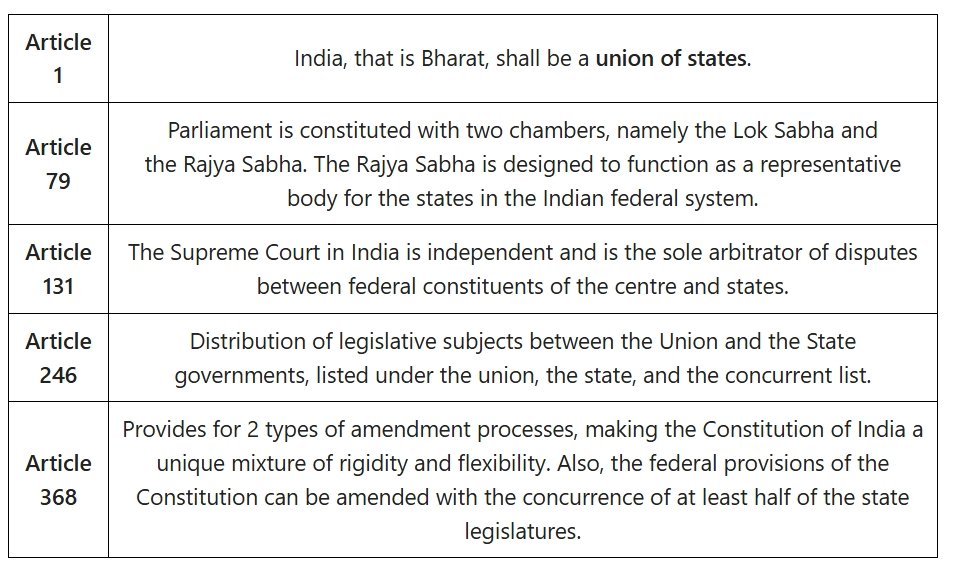
What are the federal provisions under the Indian Constitution?
Indian Constitution establishes dual polity ( Article 1 read with Part V and Part VI) and the division of powers between them ( Article 246 read with the 7th Schedule) . The states have the same authority over the state list during ordinary times as the union has over the union list. Part VI of the Indian Constitution provides for the states of the Indian Union with independent constitutional existence.
conclusion
Thus from the above discussion it is clear that India is a federal state. But we can also notice that some of its features are unitary which makes india as unitary state. so india is both a federal and unitary unity.